VAT on a business purchase can reduce the tax you pay to the state. But a work-related expense and an invoice with your NIF do not, on their own, guarantee a deduction. Your VAT regime, the purchase’s use and statutory exclusions all matter.
How the calculation works
In a simplified example, you charged clients €2,300 VAT during the quarter and have €374 of legally deductible input VAT. Without other adjustments or earlier credits, you pay €2,300 − €374 = €1,926.
You deduct eligible VAT, not the total expense. A €123 purchase containing €23 of fully deductible VAT gives a €23 deduction. That is not a 23% discount on the €123 paid.
Start with your VAT regime
If you are covered by the article 53 exemption, you cannot deduct input VAT under that regime. Being below a turnover threshold does not, by itself, prove you are exempt: check your activity’s registered treatment.
Under the normal regime, deductibility depends on your transactions and how the purchase is used. Businesses making transactions with and without deduction rights may need direct allocation or a pro rata calculation. Charging VAT on one invoice does not make every purchase deductible.
You can opt out of the article 53 exemption, but that brings obligations. Assess it against your sales and costs, rather than one planned purchase alone.
You need an invoice; a NIF is not permission
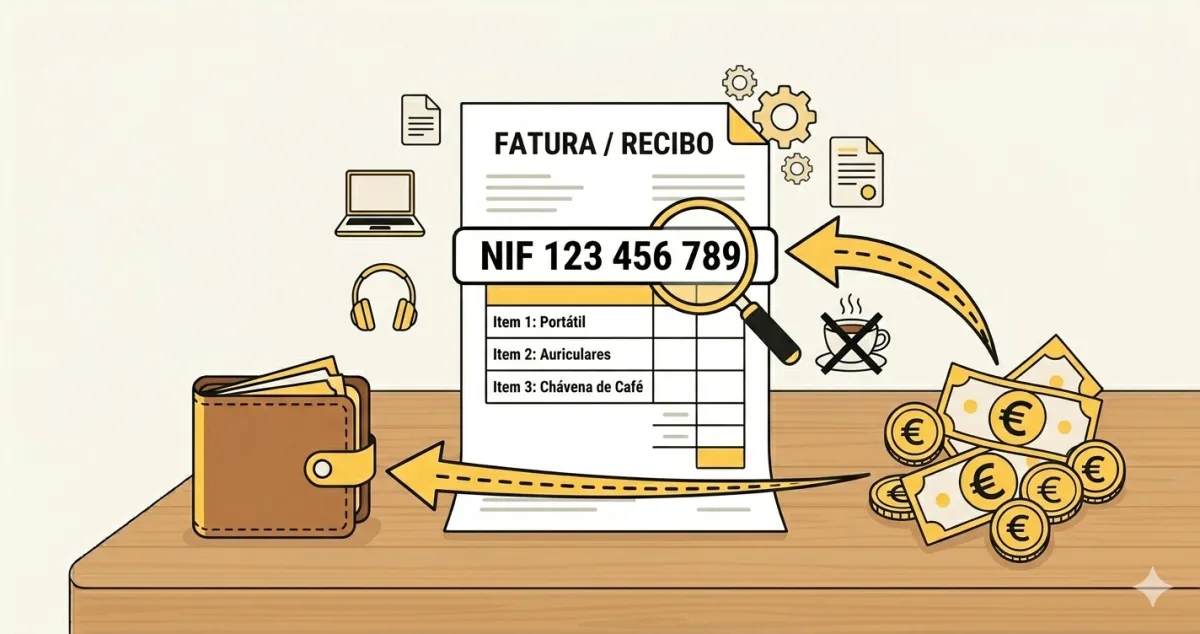
Keep a legally compliant invoice issued in your name with your NIF, plus evidence connecting the purchase to your activity. Articles 19 and 20 of the Portuguese VAT Code set documentary and substantive conditions.
A laptop used for the activity or office paper may qualify if the other conditions are met. If a purchase has no VAT charged, there is no such VAT to deduct; purchases from abroad can have separate reverse-charge rules.
Some business expenses have excluded VAT
Article 21 contains exclusions and exceptions. Vehicles, fuel, travel, accommodation and meals need particular attention. Visiting a client does not automatically make the VAT on fuel, tolls or lunch deductible.
Check the type of expense, the vehicle or activity involved, and any applicable statutory exception before claiming. Avoid lists promising deductions for “every business expense with a NIF”.
Different purchases on one invoice
Imagine a stationery purchase containing €30.75 of paper for your business and €12.30 of supplies for personal use, both with VAT at 23%. The invoice totals €43.05, including €8.05 VAT.
If the paper qualifies for full deduction, its deductible VAT is €5.75. The €2.30 VAT on the personal purchase is not part of the business deduction.
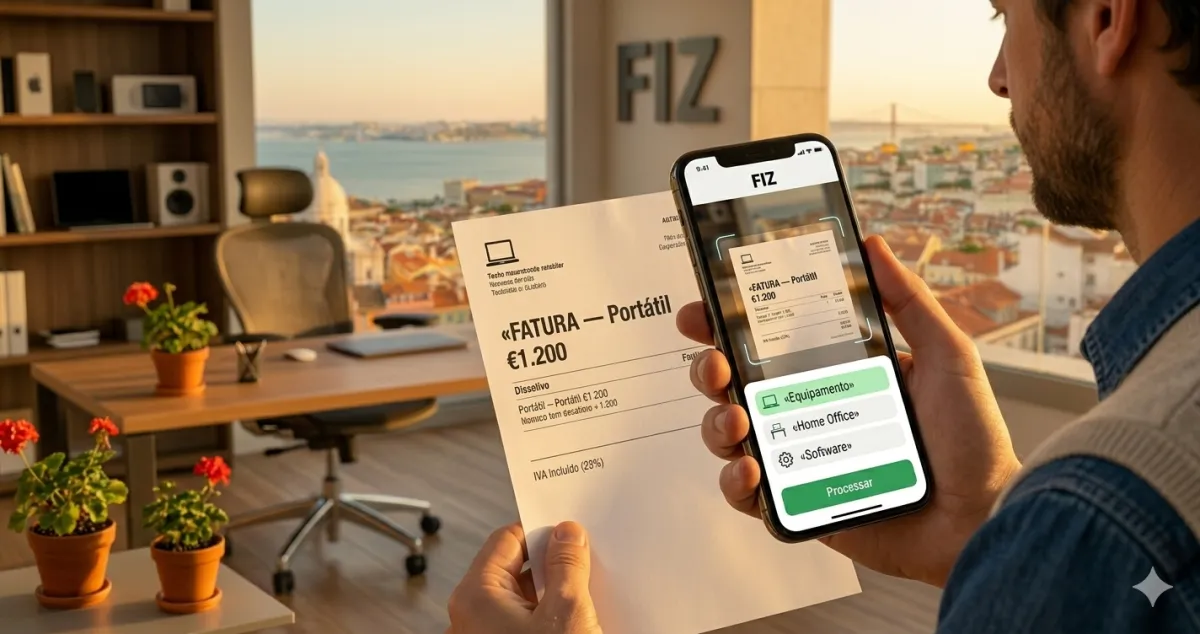
In FIZ, you can split the document’s purchases into parts with separate categories and allocations. The October product update demonstration shows this classification. Availability depends on the profile’s plan or assigned access.
One item used both ways is different
A phone used for work and personal life is one purchase with mixed use. That is different from two distinct purchases on the same receipt.
Do not choose an arbitrary percentage or assume the percentage accepted for IRS is also right for VAT. Deduction requires assessing the use, applicable rules and supporting evidence. Software classification organises the information; it does not create a deduction entitlement.
Before filing the return
Check the invoices, regime, categories and VAT actually eligible for deduction. The periodic return separates deductions into the appropriate fields; you do not simply enter one undifferentiated total of purchases.
In FIZ, review expenses and proposed figures before filing. Resolve doubts about a category or purchase before confirming. Keep the documents supporting the calculation.
Reviewed in November 2026 against articles 19–23 and 53 of the Portuguese VAT Code. IRS rules for partly allocated expenses are separate from VAT deduction rules.