You just opened your activity and are already picturing mountains of paperwork, impossible deadlines, and fines? Breathe.
In the first 90 days you will spend around 2 hours on administration. The other 2,158 hours are for working and living your life.
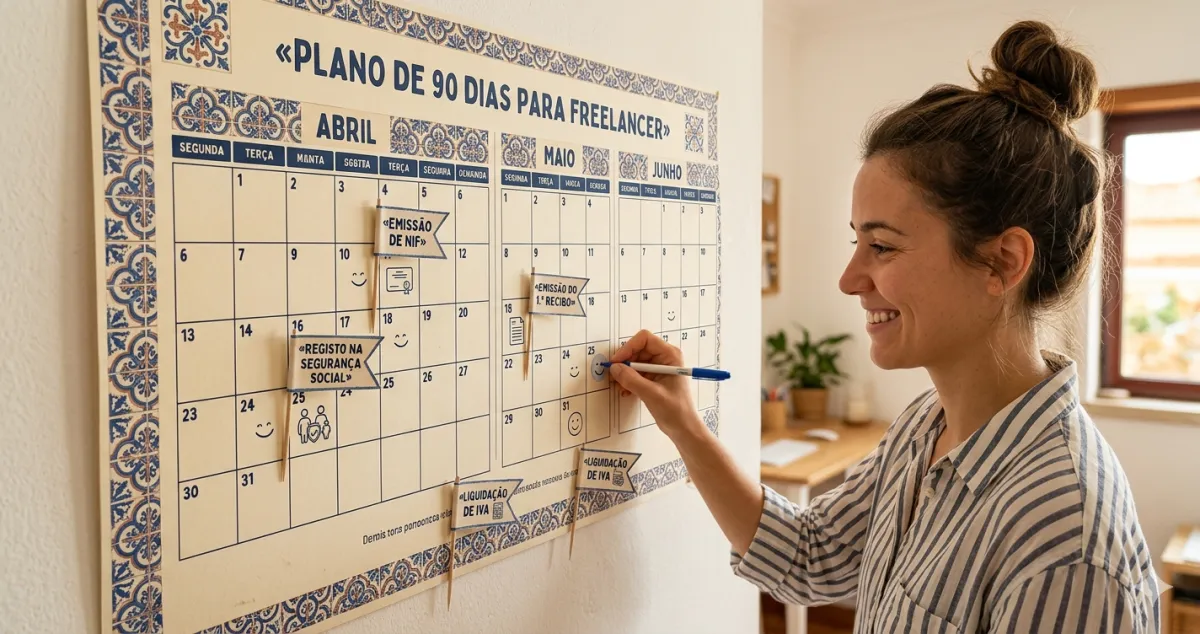
Here is the real calendar.
Week 1 — The start (30 minutes)
Open activity with the tax authority — 20 minutes Finance Portal → Serviços → Atividade → Início de Atividade. Choose Trabalhador Independente, the CAE that describes your work, simplified regime, today’s date. Submit and save the confirmation PDF.
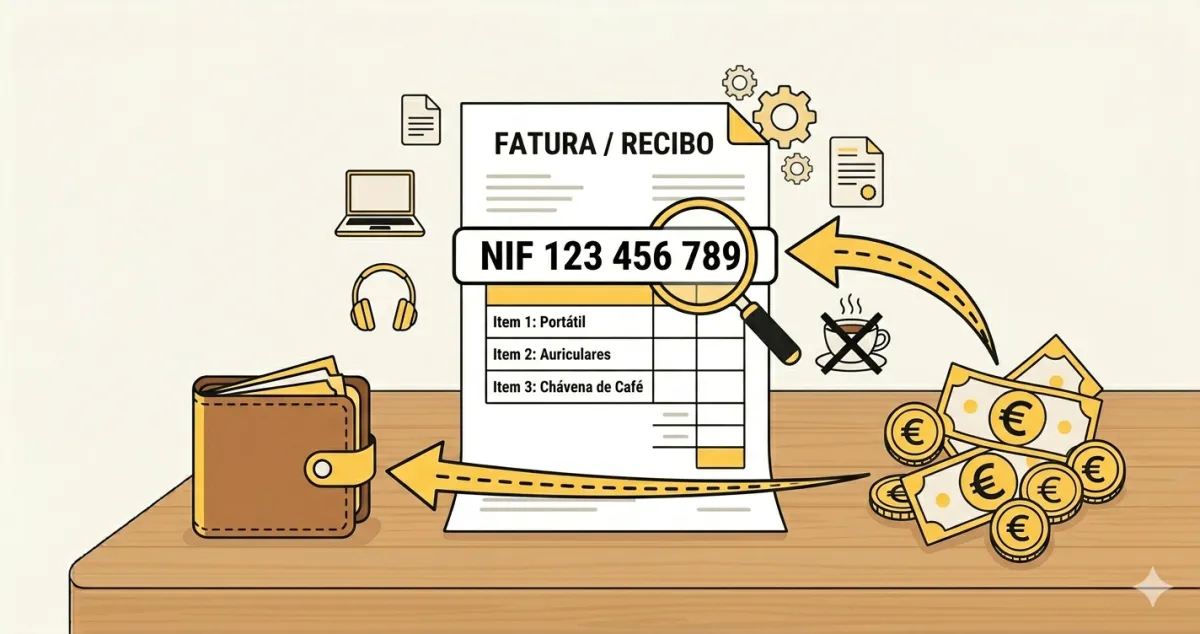
Set up invoicing software — 10 minutes You need AT-certified software to issue invoices legally. Register, enter your NIF and CAE, and you are ready to invoice.
Register on Segurança Social Direta — 10 minutes (can do on day 1) Go to segurancasocial.pt, create an account and register as an independent worker. This is a separate step from the tax authority — many people forget it.
Weeks 2 to 4 — Normal pace
You work. You issue invoices as you deliver services. Each invoice takes two minutes.
No declarations to file yet. No payments to make. You live your life.
Note on VAT: if the forecast you stated on opening is up to €15,000 for the remainder of the calendar year (no conversion to an annual figure — that annualisation ended in 2025), you are exempt under Art. 53 CIVA. On invoices you select VAT 0% with that reason and, for your own sales, there is nothing more to do — just watch the threshold. The exception: if you buy services from foreign suppliers (Google/Meta ads, Upwork), you must self-assess VAT and declare and pay by the end of the following month.
Month 2 — Nothing new (or almost)
If you opened your activity in the first days of a quarter, month 2 passes without any declaration.
If you opened in January 2026, for example, the contribution obligation only starts on 1 January 2027 (the 1st day of the 12th month after you began) — and the first declaration is filed in April 2027. In other words: for your entire first year, zero Social Security declarations. For your exact month, use the first-declaration calculator — enter your start date and see the dates.
For most people in the first month: zero extra obligations.
Month 3 — The first check-in
At the end of the third month it is worth checking two things:
1. Quarterly VAT If you are exempt under art. 53.º (turnover in Portuguese territory up to €15,000/year), you have no regular return to file — and even if you pass €15,000 during the year, the exemption holds until 31 December (it only ends immediately above €18,750); the standard regime starts on the following 1 January. In the standard regime, you file the periodic return by the 20th of the second month after the quarter ends (Q2 extends to 20 September).
| Quarter | Period | Deadline |
|---|---|---|
| Q1 | Jan–Mar | 20 May |
| Q2 | Apr–Jun | 20 Sep |
| Q3 | Jul–Sep | 20 Nov |
| Q4 | Oct–Dec | 20 Feb |
2. Social Security In the first year there is full exemption from contributions. You do not pay or declare anything during the first 12 months of activity. Obligations begin from month 13.
The 90-day summary
| Task | When | Time |
|---|---|---|
| Open activity | Day 1 | 20 min |
| Set up software | Day 1 | 10 min |
| Register on SS Direta | Day 1 | 10 min |
| Issue each invoice | As you work | 2 min |
| Check VAT deadline | End of each quarter | 5 min |
Total administration in 90 days: ~1 hour (excluding invoices, which are normal work).
What you do NOT need to do in the first 90 days
- Hire an accountant (not required on the simplified regime)
- Pay Social Security (exemption in the first year)
- File an IRS declaration (annual, between April and June of the following year)
- Do anything on paper
✅ In summary
-
Day 1: three tasks — open activity with the tax authority, set up certified invoicing software, register on Segurança Social Direta. Takes under an hour in total.
-
In the first 12 months there is a Social Security exemption — you do not pay or declare contributions during that period.
-
With FIZ the invoicing software is ready in minutes and quarterly declarations are automatic — the obligations calendar requires no constant attention on your part.