
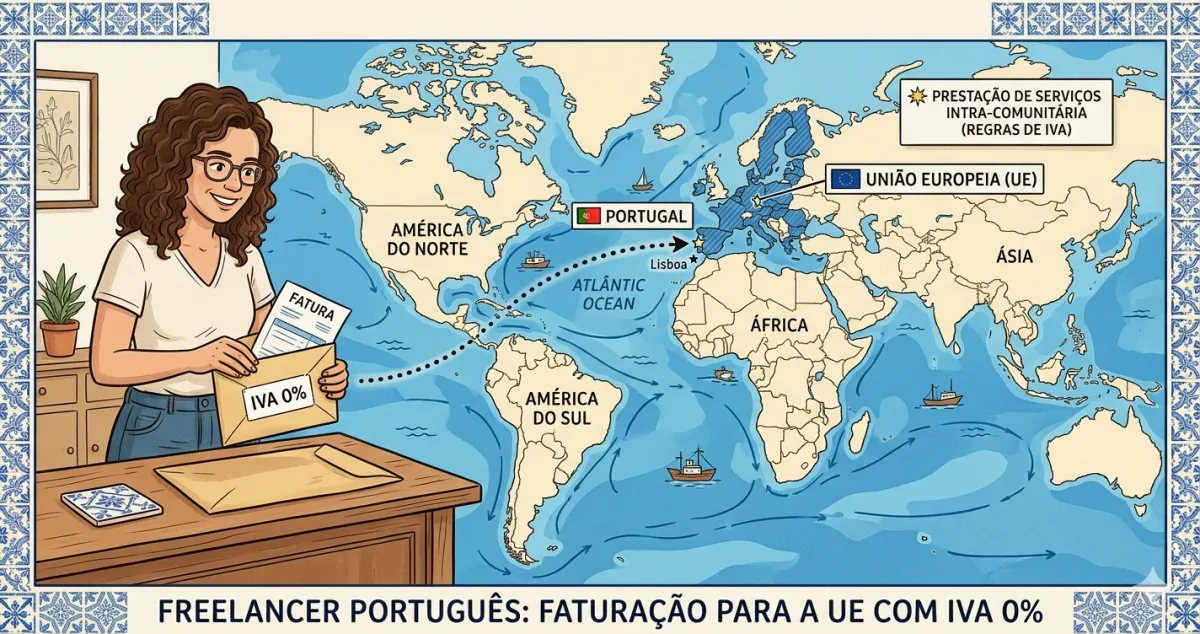
You received a quote request from a German company or a client in Brazil. Good news — but immediately after comes the question: VAT or not? What NIF do I use? What currency do I invoice in?
The rules depend on two factors: where the client is and whether they are a business or an individual.
Case 1: company in the European Union (B2B)
Rule: you do not charge VAT. The client pays VAT in their country — this is called the reverse charge mechanism.
On the invoice:
- Client’s EU VAT number (starts with the country code: DE for Germany, FR for France, etc.)
- VAT: 0% — reverse charge / Art. 6 CIVA
- Mandatory note: “VAT — reverse charge by the acquirer”
What you need to do beyond invoicing: If you are in the standard VAT regime, you must report these service supplies in your periodic VAT return — in field 7 of Quadro 06 (operations listed on the recapitulative statement) — and on the recapitulative statement itself (the periodic intra-Community operations list). Don’t confuse this with fields 16–17, which are for services you buy from EU suppliers.
Tip: always verify the client’s EU VAT number on the VIES system (ec.europa.eu/taxation_customs/vies) to confirm it is valid.
Case 2: private individual in the European Union (B2C)
Rule: you charge Portuguese VAT normally — 23% for general services.
Exception: the €10,000/year OSS (One Stop Shop) threshold only covers distance sales of goods and digital/TBE services (telecommunications, broadcasting and electronically supplied services — automated courses, downloads, subscriptions). Design, translation or personalised consultancy for EU individuals stay outside it: there you charge Portuguese VAT, with no value limit.
Case 3: client outside the European Union (USA, UK, Brazil, Switzerland, etc.)
Non-EU business: no VAT — the service is deemed located in the client’s country (art. 6.º n.º 6 of the CIVA).
Non-EU private individual: the general rule would be Portuguese VAT — but art. 6.º n.º 11 of the CIVA takes intellectual-type services supplied to non-EU individuals out of Portugal: consultancy, engineering, legal services, translation, advertising, data processing, among others. Since that covers most freelancer services (design, programming, consultancy, translation), in practice you also invoice without VAT — but confirm your activity is on the n.º 11 list; if it isn’t (for example, in-person services), you apply Portuguese VAT.
On the invoice:
- NIF: leave the Portuguese NIF field empty and identify the client as a non-resident, with whatever foreign details you have (the 999999990 code is used only when generating the SAF-T file — it is not the client’s NIF on the invoice)
- VAT: 0% — operation not located in Portugal / Art. 6 CIVA
No special reporting obligations for non-EU clients beyond the standard filings.
VAT rules summary
| Client type | VAT on invoice | Reason |
|---|---|---|
| EU company (B2B) | 0% | Reverse charge |
| EU individual (B2C) | 23% | Portuguese VAT |
| Non-EU company (B2B) | 0% | Service located in the client’s country (art. 6.º n.º 6) |
| Non-EU individual (B2C) | 0% if the service is on the art. 6.º n.º 11 list (most freelancer services); otherwise 23% | Portuguese VAT by default |
Important note: if you are exempt under Art. 53 CIVA (annual invoicing up to €15,000), for domestic clients you apply 0% with the Art. 53 reason (M10). But watch out with foreign clients: when the operation is not located in Portugal, the correct reason on the invoice is Art. 6.º — M40 for businesses (the general B2B rule) or M44 for the n.º 11 services to non-EU individuals — not Art. 53. The tax authority has ordered documents cancelled for using the wrong reason in exactly this case.
What currency to invoice in?
You can invoice in any currency — dollars, pounds, Swiss francs. What matters for Portuguese tax purposes is the value in euros.
Recommended practice: invoice in euros whenever possible. If the client insists on another currency, convert at the day’s exchange rate and record the euro value in your invoicing system.
IRS with foreign clients
Foreign clients do not withhold Portuguese income tax. That is always your responsibility. You receive the full amount and pay all the IRS in your annual declaration.
✅ In summary
-
EU company = 0% VAT with reverse charge; EU individual = 23% VAT; outside the EU = 0% for businesses and for intellectual-type services to individuals (art. 6.º n.º 11) — most freelancer services.
-
Foreign clients do not withhold Portuguese income tax — you receive everything and pay the tax in your annual declaration. Always set aside 15–25% of each invoice.
-
With FIZ the software identifies the client type and automatically applies the correct VAT rules — you do not need to memorise the distinctions for each situation.