
Maria has been a freelance graphic designer for four years. She invoices an average of €1,100 a month, has one main client and two or three occasional ones. Every month she pays €300 to an accountant.
What does the accountant do? She receives the invoices Maria has already issued, submits the quarterly Social Security declaration and handles the IRS once a year. There’s no VAT declaration at all in Maria’s case — exempt under Article 53 of CIVA (she invoices under €15,000/year), she doesn’t file the periodic return.
In a conversation with a friend, Maria realised for the first time that she was not required to have an accountant. The law is clear on this.
What the law says
The IRS Code and the Commercial Code establish that independent workers on the simplified regime are not obliged to have a Certified Accountant (TOC). This obligation only exists in two situations:
- Annual turnover above €200,000 two years in a row, or above €250,000 in a single year (the threshold plus 25% — art. 28.º n.º 6 of the CIRS) — in which case you switch to organised accounting from the following period, and that requires a certified accountant
- Voluntary choice of organised accounting — if you decide to opt for this regime instead of the simplified one
Below €200,000 and on the simplified regime? The law does not require you to have anyone. It is an option, not a requirement.
What the simplified regime actually is
There is a misunderstanding worth clearing up because it is the root of much confusion: the simplified regime is not a generous concession from the state, nor something you can lose by not having an accountant. It is simply a different way of calculating taxable income.
Instead of presenting your actual expenses and having the state calculate your profit, the state applies fixed coefficients:
- 0.75 for the professional activities in the art. 151.º table (most service freelancers; other services use 0.35 — see which coefficient is yours)
- 0.15 for product sales in wholesale or retail
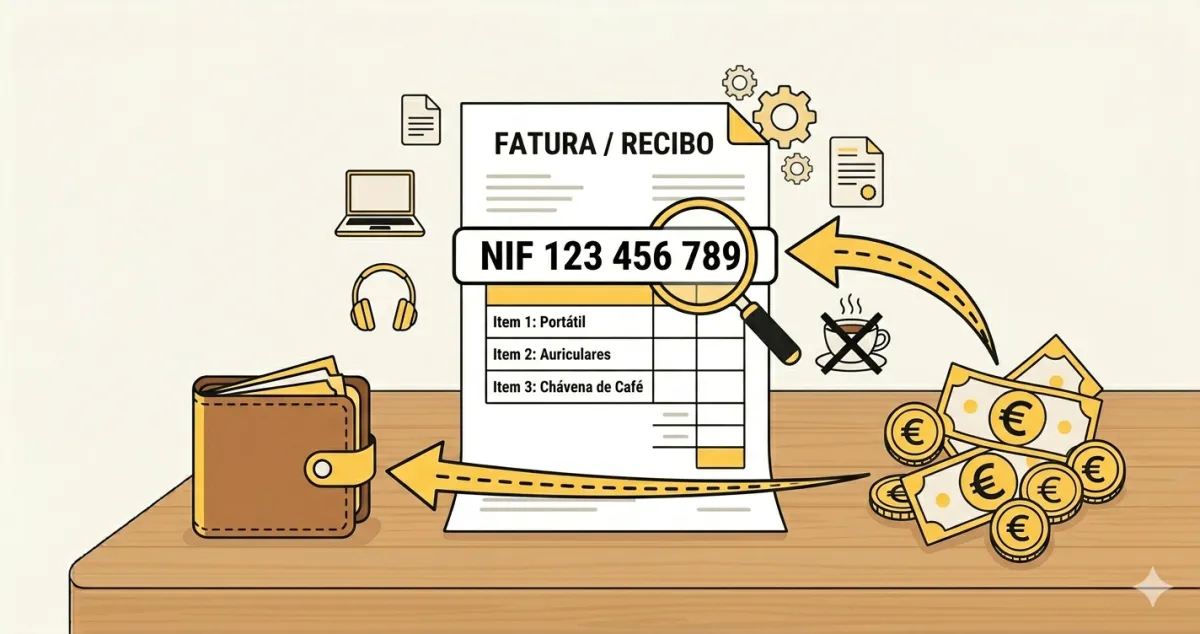
The “discount” lives in the coefficient, but it is not 100% automatic: of the presumed 25%, 15% must be justified (art. 31.º n.º 13 of the CIRS). In practice, the standard deduction or the part of your SS contributions up to 10% of gross income (the higher of the two counts) covers that requirement for incomes up to around €30,000/year; above that, ask for invoices with your NIF and classify the expenses in e-Fatura — or the difference is added back to your taxable income.
Your actual obligations (without an accountant)
The simplified regime without a TOC does not mean zero obligations. It means the obligations are managed by you — or by certified tools. They are always the same:
Certified invoicing. All invoices must be issued using AT-certified software, with ATCUD and QR code. You cannot use Word or Excel to issue invoices — they are not legally valid.
Quarterly VAT declaration. It only exists in the standard regime: you file the periodic declaration by the 20th of the second month after each quarter ends (Q2 extends to 20 September). Invoicing up to €15,000/year you are exempt under art. 53.º and don’t have this regular obligation — you only file for periods in which you self-assess VAT on purchases from foreign suppliers. And even when you pass €15,000, as a rule you only switch regimes on the following 1 January (immediately only if you pass €18,750).
Quarterly Social Security declaration. Filed during the month following the end of the quarter — January, April, July and October, by the last day of the month. Contributions are then paid between the 10th and 20th of each month. In your first year of activity you benefit from a full exemption — no payments and no declarations.
Annual IRS. Once a year, between April and June.
The most important point: the exemption is neither automatic nor eternal. Maria, VAT-exempt because she invoices under €15,000/year, pays no VAT and files no periodic declaration — but the exemption must be formalised in her activity registration, and it’s on her to watch the threshold: if she crosses it and doesn’t report the change to the tax authority, the consequences could be significant.
”But what if I make a mistake?”
This is the question that keeps many people paying a TOC when they don’t need one. The fear of getting a declaration wrong, miscalculating, missing a deadline.
The objective answer is that the risk exists — but it is manageable. The most common mistakes always have a correction window before generating a fine. The Tax Authority and Social Security notify first, apply sanctions later. And certified software has safeguards that warn you when something is missing or overdue.
The alternative of paying €300/month to eliminate that risk represents, in Maria’s case, €3,600 a year — more than three months of invoicing. For a service she could do herself in under an hour per quarter.
When a TOC actually makes sense
There are situations where an accountant is not a luxury but a necessity:
- Turnover heading towards organised accounting — above €200,000 two years in a row, or €250,000 in a single year
- Clients in other EU countries (recapitulative declarations, VAT reverse charge)
- Complex expenses you want to deduct that require validation (expensive equipment, vehicles, property used for the business)
- Mixed tax situations (self-employment plus employment income, rental income, capital gains)
For a freelancer providing services, invoicing up to a few thousand euros per month, with clients mainly in Portugal? The law does not require a TOC, and certified tools allow you to meet all obligations without outside help.
✅ Summary — 3 key points
✅ The law is clear: on the simplified regime with annual turnover below €200,000, you are not legally required to have a TOC — it is a choice, not a requirement, and most service freelancers will never need to reach that threshold.
✅ Your actual obligations: certified invoicing (ATCUD and QR code mandatory), the quarterly Social Security declaration, and annual IRS. The periodic VAT declaration only exists in the standard regime — invoicing up to €15,000/year you are exempt under Article 53 and don’t file it regularly (apart from months with self-assessed VAT on foreign purchases). And remember: the exemption must be formalised in your activity registration, and if you cross the threshold you must report the change to the tax authority.
✅ Certified software replaces the TOC for most freelancers: tools like FIZ handle legal invoicing, submit quarterly declarations automatically, and show your tax position in real time — without the €300/month Maria was paying for services she could have done in 5 minutes.