
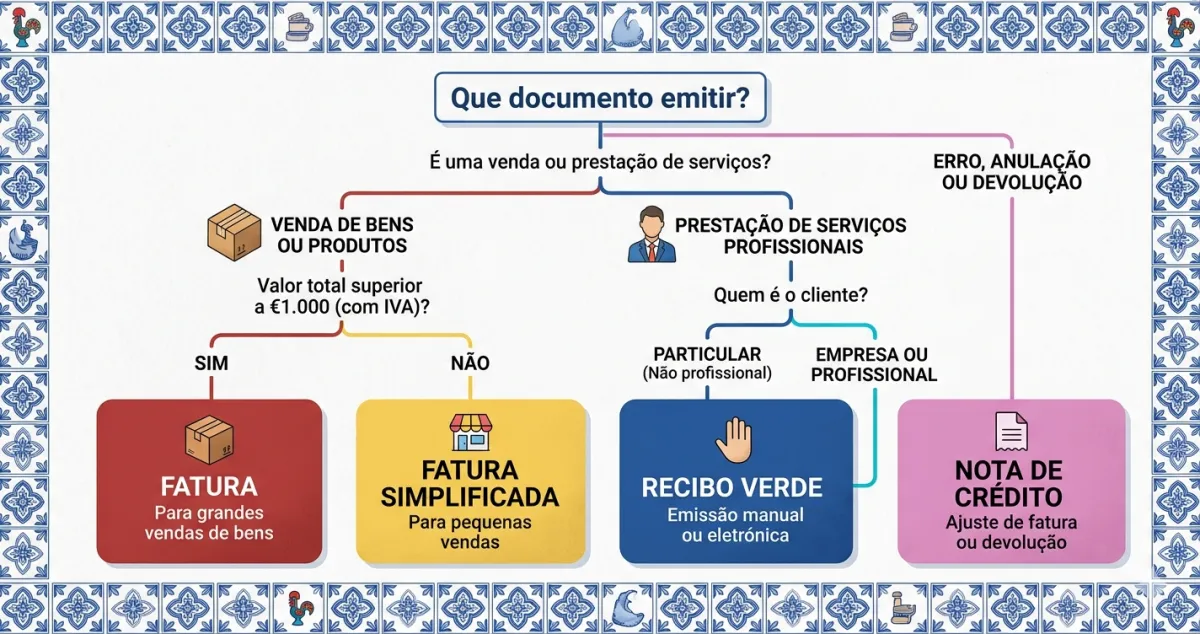
The client has approved the work and now wants the tax document. And there you are, wondering: recibo verde? Fatura? Fatura-recibo?
The answer is simpler than it looks — and it comes down to two questions.
Question 1: when does the client pay?
This is what decides the document type — and it applies to every client, from your neighbour in Lisbon to a startup in Berlin:
- Paid at the moment of the service? You issue a fatura-recibo — the classic “recibo verde”, combining invoice and proof of payment in one document. It’s the most common case among freelancers.
- Paying later (at 30 days, say)? You issue the fatura first (it formalises the debt) and, when the money arrives, the recibo (it acknowledges payment).
The type of client doesn’t change this: a German company can receive a fatura-recibo (if it pays right away) just as well as a fatura followed by a recibo.
Question 2: who is the client?
The client doesn’t change the document type — it changes what goes inside it: the NIF, the withholding tax and the VAT treatment.
Private client without a Portuguese NIF
Ana, a French tourist, wants some documents translated. She has no Portuguese NIF — and private individuals aren’t required to give one:
- Leave the NIF field empty and select “Consumidor final” (final consumer)
- Select 0% VAT with the exemption reason, if you’re exempt under art. 53.º
Private client with a NIF
Pedro wants guitar lessons and gives you his NIF:
- Enter his NIF on the document
- Everything else is the same — VAT according to your regime
Portuguese company
Sofia runs a marketing agency in Lisbon and hired you for copywriting. This is where withholding tax comes in:
- If the company has organised accounting (most companies do), it withholds 23% of the amount and remits it to the tax authority on your behalf (art. 101.º of the CIRS, professions in the art. 151.º table; other Category B activities have their own rates — 11.5% or 16.5%)
- The withholding happens at the moment of payment: on a fatura-recibo it goes straight on the document; if you issue a fatura and the client pays later, it’s the recibo that carries it — on the fatura you can leave just an informative mention
- Example: you invoiced €1,000 → you receive €770; the €230 is income tax paid in advance, settled in your annual return
- If you expect to invoice under €15,000 this year (and didn’t reach that amount last year), you can waive the withholding (art. 101.º-B) — you state on the document “Sem retenção, nos termos do n.º 1 do artigo 101.º-B do CIRS” and receive the full €1,000. How it works in detail: retention at source explained
EU company
Bruno works for a German startup. The document is the same (fatura or fatura-recibo, depending on payment) — what changes is the VAT:
- You apply the reverse charge — 0% VAT, with the mention “IVA - Autoliquidação”
- The German company handles VAT in its own country
- There’s no withholding — it only applies to entities here in Portugal
- In the standard VAT regime, you also file the Recapitulativa declaration (those exempt under art. 53.º are excused)
The most common mistake
Issuing a document without a NIF to Portuguese companies. Companies always need a document with their NIF on it. Without it, they can’t deduct the expense — and they’ll ask you to correct it.
Everyday examples
The graphic designer:
- Dona Lurdes from the bakery (with NIF, pays on the spot) → fatura-recibo with her NIF
- American tourist (no NIF, pays on the spot) → fatura-recibo to “Consumidor final”
- Worten (pays at 30 days) → fatura; on the recibo, when it pays, the 23% withholding applies
- Agency in Paris → fatura-recibo with reverse charge
The translator:
- Sr. António for a job application → fatura-recibo
- Company in Barcelona → fatura with reverse charge, recibo on receipt
- Continente → fatura; 23% withholding on the recibo, on receipt
Special cases
Foreign client outside the EU? If it’s a business, same logic as an EU client — the service isn’t taxed here, 0% VAT, but no Recapitulativa declaration. If it’s a private individual, the general rule is normal Portuguese VAT — there are exceptions for some services (art. 6.º of the CIVA), so check the guide to invoicing foreign clients before issuing.
Client doesn’t want to give a NIF? Private individuals aren’t required to — issue to “Consumidor final”. Companies must always give a NIF.
Invoicing EU companies in the standard VAT regime: Recapitulativa declaration (on quarterly VAT, by the 20th of the month following the quarter — earlier than the periodic VAT return). The details are in the recapitulativa guide.
✅ In summary
-
The moment of payment decides the document: paid on the spot → fatura-recibo; paying later → fatura first, recibo when the money arrives. The same for every client.
-
The client decides what goes inside: private individual without NIF → “Consumidor final” | Portuguese company → withholding on the recibo — 23% for art. 151.º professions, other rates for other activities (unless waived, up to €15,000) | EU company → reverse charge and, in the standard regime, the Recapitulativa.
-
With FIZ the system automatically suggests the right document — enter the client’s NIF and FIZ detects whether they’re a company or an individual, applies withholding and reverse charge where they’re due, and even submits the Recapitulativa declaration when needed.